
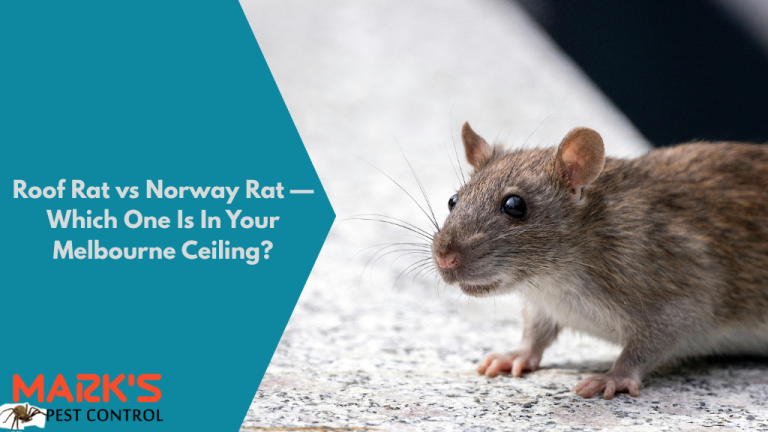
Marks Pest Control gets asked a version of this question almost every week: scratching noises overhead but is it a roof rat or a Norway rat in Melbourne roof spaces? The two species look similar at a glance, but they move through a house differently, nest in different spots, and get in through different gaps. Knowing which one you're dealing with makes it much easier to work out where it's coming from.
Roof rats and Norway rats are different in body shape, tail length, and where they nest. A roof rat is slim with a tail longer than its body and climbs into ceiling cavities and roof voids. A Norway rat is heavier-set with a tail shorter than its body and stays closer to ground level, in subfloors, drains, and garden beds.
Identifying a roof rat
Roof rats (also called black rats) are the climbers of the two species. A few things set them apart:
- Slim, streamlined body, usually 16–20cm long excluding the tail
- Large ears and a pointed nose
- Tail noticeably longer than the head and body combined
- Droppings are spindle-shaped with pointed ends, usually scattered
Because roof rats climb well, they tend to enter a home high up. Once inside, they favour ceiling cavities, wall voids near the roofline, and the space above insulation. Noises from a roof rat are usually heard directly overhead, often at night, moving along beams or across the ceiling sheet. Outside, look for gnaw marks on power lines, activity along fence tops, or a rat moving through tree canopy that overhangs the roof.
Identifying a Norway rat
Norway rats (also called brown rats or sewer rats) are built for burrowing rather than climbing:
- Heavier, thicker body, usually 20–25cm long excluding the tail
- Smaller ears relative to the head, blunt nose
- Tail shorter than the head and body combined
- Droppings are capsule-shaped with blunt ends, often in a cluster near a feeding spot
Norway rats stay low. Subfloors, garden beds, compost areas, woodpiles, and drainage systems are where they set up. Inside a home, noise from a Norway rat is more likely to come from under the floor or behind low skirting rather than overhead. They're strong diggers, so a burrow entrance near a foundation, shed base, or garden edge is a common sign.
Side-by-side: what to look and listen for
Putting the two together, a few quick checks help narrow it down without needing to see the rat itself:
- Where the noise comes from — overhead and in the ceiling points to a roof rat; under the floor or along skirting points to a Norway rat
- Droppings — spindle-shaped and scattered suggests a roof rat; capsule-shaped and clustered suggests a Norway rat
- Outdoor sightings — a rat on a power line, fence, or in a tree points to a roof rat; a rat near a drain, compost bin, or burrow entrance points to a Norway rat
- Tail length — longer than the body means roof rat; shorter than the body means Norway rat
Entry points: where each one gets in
Roof rat entry points
Usually well above ground level:
- Gaps where roofing meets the fascia or eaves
- Broken or missing roof tiles and unsealed ridge capping
- Vents, whirlybirds, and eave gaps without mesh covering
- Overhanging tree branches or power lines that give direct access to the roofline
Norway rat entry points
Sit closer to the ground:
- Gaps around subfloor vents
- Cracks in foundations or where pipes pass through external walls
- Unsealed gaps around stormwater and sewer connections
- Low gaps under doors, garages, or sheds
How this plays out across Melbourne
Marks Pest Control covers rodent activity statewide across Victoria, and the mix of roof rats and Norway rats tends to shift depending on the type of housing in an area.
Northcote
Older weatherboard and brick homes with roof voids sitting close to mature tree canopy create good climbing access, so roof rat activity in ceilings is common.
Mornington
The mix of older coastal homes and newer builds means both species turn up — roof cavities are accessible in older properties, while gardens and drainage near the coast suit Norway rats too.
Melton
Many homes sit on the edge of open paddock land, and Norway rats moving in from surrounding blocks toward subfloors and garden beds is a frequent pattern, especially as the weather cools.
Cardinia
A similar pattern shows up — newer estates backing onto undeveloped or semi-rural land see Norway rats using drainage lines and garden beds as a route toward subfloors and low external gaps.
What to do next
Working out which species is present is the first step in figuring out where it's getting in and what needs to be sealed. If you're hearing movement in the ceiling or under the floor and want a clearer read on which rat you're dealing with, our Rodent Control Melbourne covers both roof rats and Norway rats across Melbourne. You can also head back to the Marks Pest Control to see the full range of areas covered statewide.
FAQs
Is a roof rat the same as a Norway rat?
No. They're different species with different body shapes, tail lengths, and habits. Roof rats climb and nest in ceilings and roof voids, while Norway rats stay closer to ground level in subfloors and gardens.
Why do I only hear noise in my ceiling at night?
Both species are more active after dark. Noise directly overhead, especially at night, is more typical of a roof rat moving through the ceiling cavity or along roof beams.
Can a Norway rat climb into a roof space?
It's less common. Norway rats are built for digging and ground-level movement rather than climbing, so a rat in the ceiling is more likely to be a roof rat, while one under the floor is more likely a Norway rat.
What's the easiest way to tell the two apart without seeing the rat?
Droppings and location are the two most useful clues. Spindle-shaped droppings scattered near the ceiling point to a roof rat, while capsule-shaped droppings clustered near the floor or garden point to a Norway rat.